|
Felt is foremost a pliable material. It is relatively elastic, so to
some degree small dimensional errors can be compensated for. Highly reliable
woolen felt conforming to the JIS L3201 standard is also available. It
has a remarkable ability to maintain its shape, and if deformed it can
be easily returned to its original shape. It breathes well, holds water,
dyes readily, and has good fluid permeability.
Second, it is flexible. Felt can be thick, thin, pliable, or rigid. It has excellent dyeing properties, and can be dyed any color.
In addition, because felt has heat insulating properties, heat retaining properties, is shock absorbent, and can shut out sound, it has uses in many fields. Its future applications will likely be limitless.
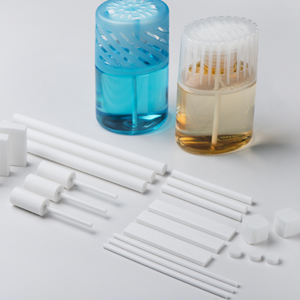
Can you develop something like this?
Has something like this been made before?
Please contact us with even the smallest hint. We are certain we will be of help. Please do not hesitate to make use of our technological strengths and the know-how we have accumulated over the years to achieve the goals of your company. |
|
Technological strengths
|
|
Since "fallen hair," which occurs during the raw wool spinning process, is used and consistency of quality is difficult to maintain, a high level of technological capability and know-how is required. A roll of felt comes in a standard width of 1.8 meters but its volume and weight depend on the thickness of the material, its length, and its density.
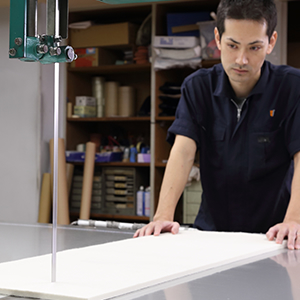
Experience and technological capability are also required in determining
the cutting dimensions, and special cutting tools are used. The quality
of Japan's woolen pressed felt is among the best in the world, but the
entire process from raw wool to end product is enormous. Many important
steps in the process still require skilled craftsmen to complete, so it
has not become fully automated. It is up to us to improve production efficiency
by more fully automating felt production without sacrificing the intrinsic
qualities of the wool itself, such as its texture, feel, and warmth.
|
|